

"Does Google penalize AI content?" is the most frequent question site owners ask on this topic. The short answer: not because of AI; yes because of lack of value.
The fuller answer is a bit more nuanced. Whenever we talk about Google's position, the source is Google's official guidance for content creators in Search Central. This guidance is updated from time to time; before any important decision, read the latest version.
What does Google officially say about AI content?#
The criterion is quality and purpose, not the tool. Google's position can be summarized in four sentences:
- Helpful, reliable content is rewarded, no matter how it was made.
- Using automation, including AI, with the primary purpose of manipulating rankings violates spam policies.
- Content written for people is preferred over content made only for search engines.
- AI can be a tool for making helpful content, and Google has explicitly accepted this.
Where is the real red line?#
In mass-producing low-value pages to gain rankings, by any method. In its spam policies, Google defines "scaled content abuse" as generating many pages whose main purpose is to manipulate rankings and that offer little value to readers.
The important point is that this policy does not care about the production method. A hundred low-value pages written by a few hurried writers are covered just as much as a hundred machine-made ones. Examples that fit this definition:
- Hundreds of generic articles generated from a keyword list.
- City-by-city pages with identical text where only the city name changes.
- Automatically rewriting other sites' articles without adding anything.
- Mass machine translation without review.
The same logic applies to stores; we wrote about the right way to write product descriptions in WooCommerce product descriptions with AI.
How does Google know content is low-value?#
With automated spam and quality systems, alongside human review; not with "AI detection". Google does not publish the details of these systems, but it has named one of its anti-spam systems SpamBrain, and it has teams that record manual actions.
The signs of low-value content, for a human reviewer or a machine, are the same as always:
- The page has nothing more than other results.
- The number of pages suddenly grew but quality and audience did not grow with it.
- Hundreds of pages share the same template and structure.
- There is wrong information, unsourced claims and outdated data in the text.
Why is "experience" the most important thing a model lacks?#
Because the model already has general knowledge, and what is scarce is first-hand experience. E-E-A-T is a framework Google uses to assess quality: experience, expertise, authoritativeness and trust. This framework appears in Google's quality rater guidelines; raters do not directly set rankings, but they show what Google is looking for.
A model can write the general definition well, but it cannot tell you what error you saw when you installed this plugin yourself on shared hosting. That very detail is valuable both to readers and to assistants looking for citable sources; we said this in SEO for AI engines too.
The rater guidelines place pages whose main content was made with little effort and without originality or added value, including with automated tools, at the lowest quality level. That means publishing the model's raw output is exactly what you should not do.
Which AI use is risky and which is not?#
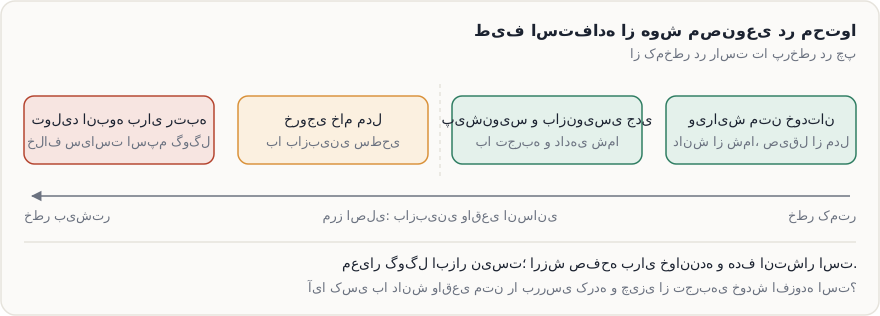
The more knowledge and experience come from you and the model only helps, the lower the risk; the more pages and the less review, the higher the risk.
| Task | Risk | Why |
|---|---|---|
| Editing and smoothing your own text | Negligible | The knowledge and experience are yours |
| Writing meta descriptions and summaries | Negligible | It summarizes existing content |
| A draft with a model, seriously rewritten with your own experience | Low | It has real added value |
| Publishing raw model output with a superficial review | Medium to high | It has nothing more than the rest of the web |
| Generating hundreds of pages from a keyword list | High | It is a case of scaled content abuse |
| Automatically rewriting other sites' content | High | It is both spam and a copyright problem |
The workflow we suggest, experience from you, structure and editing with the model and a final review by you, is described in writing articles with AI help.
Should we disclose it or not?#
In its helpful content guidance, Google suggests three questions that can be summarized as "who, how, why":
- Who created the content? A real author's name and an introduction page for them.
- How was it created? If readers would reasonably expect to know that AI was involved, an explanation is useful.
- Why was it created? If the main answer is "to get traffic from search", the problem starts right there.
One clear red line: do not invent authors. A name with no real person behind it conflicts with the "trust" part of that same framework.
What do you do if rankings drop?#
First see whether a manual action was recorded; then improve, merge or remove the weak pages. Go through these five steps in order:
- In Search Console, check the "Manual actions" section. If there is a message, the problem is specific, and after fixing it you can request a review.
- If there is no message, the drop is probably the work of automated systems. List the pages that dropped the most.
- For each low-value page, do one of three things: improve it with real experience and data, merge several weak pages into one good page, or remove it.
- Resist the temptation to regenerate all the pages with a "better prompt"; it is the same old work with a new look.
- Be patient; recovery after quality changes takes time.
We explain correct redirects and canonicals when merging pages in technical SEO for WordPress.
Where is this heading?#
Toward more value for first-hand content and more pressure on generic content. When generic text has become nearly free and Google itself shows AI-generated summaries in results, a page that only repeats general information has no reason to be clicked.
To get ready:
- Record your own experience, data and real decisions; it is exactly what nobody can copy.
- Build real author pages and make responsibility for each article clear.
- Build a direct audience, such as a newsletter or channel, so you do not depend on a single source of visits.
- Do not measure success only by clicks; also look at citations in AI answers and returning readers.
Summary#
- Google does not judge the tool; it judges quality and purpose.
- The red line is mass-producing low-value pages for rankings, by any method.
- First-hand experience is what a model's raw output lacks.
- Have a real, accountable author; do not invent names.
- After a drop, improve, merge or remove pages; do not regenerate them.