Reinforcement learning (RL) is a type of machine learning in which an "agent" learns what to do through trial and error in an environment: every action has a result, good results earn a reward and bad ones a penalty, and the agent gradually finds the strategy that collects the most reward overall.
Nobody tells the agent the right answer. It only learns afterwards whether an action worked. That is what separates reinforcement learning from other kinds of machine learning.
A simple example: training a dog#
Say you want to teach your dog to sit when you say "sit." You cannot explain what sitting means. So you wait, and every time the dog sits, you give it a treat. At first it is random, but after a few rounds the dog connects "sit," the action of sitting, and the treat.
Reinforcement learning gives a computer the same logic:
- The dog = the agent
- Your home and your voice = the environment
- Hearing "sit" = the state
- Sitting or not sitting = the action
- The treat = the reward
- The habit the dog forms = the policy
The key parts of reinforcement learning#
| Part | Meaning | Example in a racing game |
|---|---|---|
| Agent | The thing that decides and learns | The program driving the car |
| Environment | The world the agent acts in | The track and the other cars |
| State | A snapshot of the environment | Speed, position, the next turn |
| Action | What the agent can do | Accelerate, brake, left, right |
| Reward | A number that scores the outcome | Points for progress, a penalty for crashing |
| Policy | The rule for choosing an action in each state | "Brake before a sharp turn" |
The loop is simple: the agent observes the state, picks an action, the environment changes and returns a reward, and the agent improves its policy a little. This repeats thousands or millions of times.
Two core problems: delayed rewards and exploration#
Rewards are not always immediate#
In chess, a good move may only lead to a win twenty moves later. The agent has to work out which earlier actions contributed to the final result. That is why reinforcement learning optimizes the sum of future rewards, not just the next one.
Explore or exploit#
If the agent always does what has worked best so far, it may never discover something better. If it keeps trying new things, it never uses what it has learned. Balancing exploration (trying something new) and exploitation (using the best known option) is one of the central challenges. Think of choosing between your usual restaurant and a new one.
A step-by-step example: a robot in a maze#
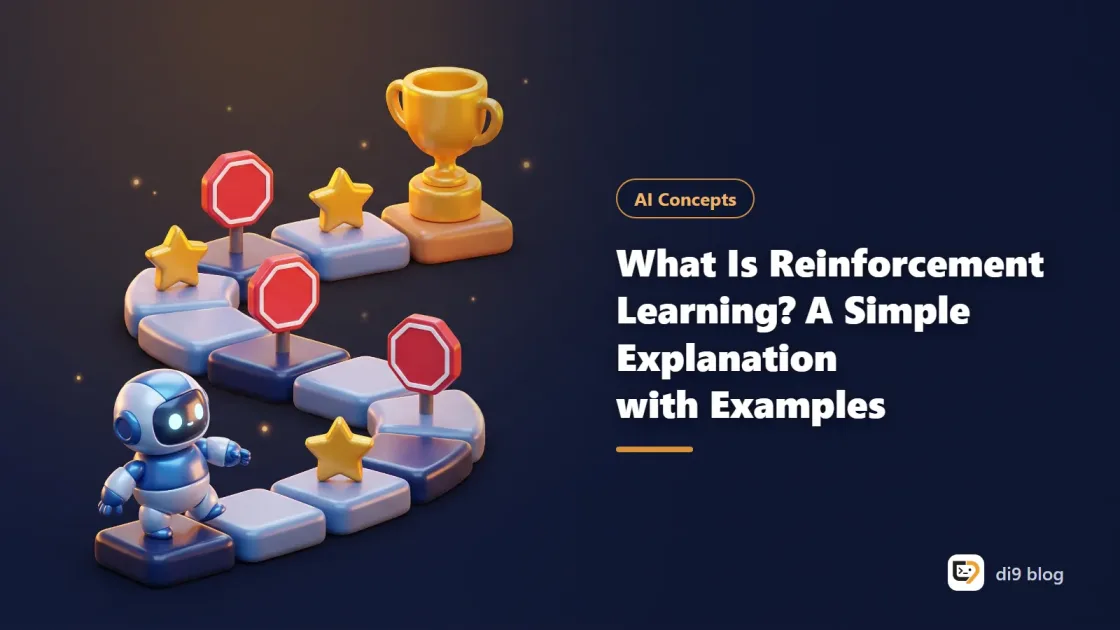
Picture a small robot in a grid maze. The goal is to reach the exit. We set the reward rules like this: reaching the exit earns a big reward, bumping into a wall earns a small penalty, and every extra step costs a little, so the robot prefers short routes.
- In the first round, the robot knows nothing and moves randomly. It hits walls many times and may reach the exit only after a long time.
- After each round, the robot updates its estimates: "From this square, going right got me closer to the exit before."
- The value of squares near the exit rises first, and that value gradually spreads back to squares further away.
- After hundreds of rounds, the robot knows the best direction from every square and takes nearly the shortest path.
Nobody gave the robot a map or the correct route. There were only rewards and penalties. That is the whole idea of reinforcement learning in a nutshell.
How it differs from supervised and unsupervised learning#
| Method | Training data | Question it answers | Example |
|---|---|---|---|
| Supervised learning | Examples with correct answers | "What is this input?" | Spam detection |
| Unsupervised learning | Examples without answers | "What patterns are in the data?" | Customer segmentation |
| Reinforcement learning | Experience and rewards | "What should I do now?" | Games, robot control |
The key point: reinforcement learning is about sequences of decisions, not a single prediction.
Types of reinforcement learning#
You do not need the math, but the main categories help you follow papers and news:
- Value-based: the agent learns how valuable each action is in each state and picks the best one. Q-learning is the best-known example.
- Policy-based: the agent improves its decision rule directly, without scoring every action.
- Actor-critic: a mix of the two; one part decides and another part judges how good the decision was.
- Model-free vs. model-based: some methods learn only from experience; others first build a model of the environment and plan with it.
- Deep reinforcement learning: when there are too many states to list (such as the pixels of a game screen), a neural network estimates values or the policy.
Where reinforcement learning is used#
- Games: programs that reached champion level at chess, Go and complex video games improved by playing millions of games against themselves.
- Robotics: learning to walk, grasp objects and move through unfamiliar spaces, usually in a simulator first.
- Chatbots and language models: large language models are often tuned after initial training with reinforcement learning from human feedback (RLHF) or similar methods so their answers are more helpful and safer. Newer techniques for improving reasoning build on the same idea.
- Agents: AI agents that take several steps in a row are conceptually close to reinforcement learning.
- Industry and infrastructure: energy optimization, scheduling, traffic control and recommendations.
Common mistakes and misconceptions#
- "The agent learns what we want." No, it learns what gets rewarded. A badly designed reward leads to strange shortcuts, known as reward hacking; for example, an agent that circles a point-scoring spot instead of finishing the race.
- "RL is good for every problem." It needs huge amounts of experience, and training is expensive and unstable. If you have labeled data, supervised learning is usually simpler.
- "What works in a simulator works in the real world." The gap between simulation and reality is a serious problem in robotics.
- "Language models are built only with RL." Most of their training is pretraining on text; reinforcement learning mainly comes in when shaping their behavior.
Summary#
- Reinforcement learning means learning by trial, error and reward, with no ready-made correct answer.
- Its key parts: agent, environment, state, action, reward and policy.
- Two core challenges: delayed rewards and balancing exploration with exploitation.
- Uses include games, robotics, tuning chatbots with RLHF and optimizing systems.
- The biggest risk is a poorly designed reward; the agent learns whatever gets rewarded.